

Four things said behind closed doors.
From board and exec conversations this month. Paraphrased, no names. Nobody is announcing any of this. They are just quietly changing how they decide.
-
1
Nobody is saying hiring freeze. They are saying think harder.
The phrase we keep hearing is do more with less.
One senior leader put it plainly: if people leave, let’s pump the brakes, re-assess, and ask whether we can use the people we already have before we re-hire.
It is not a freeze and nobody will call it one. But the default answer to a resignation has changed.
What it is doing is putting more strain on the team that is left, which is now smaller.
-
2
The cost conversation is about software, not people.
We expected to hear about headcount. We mostly heard about SaaS.
Licence costs are up 15 to 20%, largely because vendors are adding AI features and charging for them.
One exec was blunt about it. A lot of businesses do not want any of that. They just want the system to work.
-
3
Experience is winning over juniors, openly now.
This came up in three separate conversations.
Teams are smaller, budgets are tighter, and the tolerance for someone who needs eighteen months of runway has gone.
Worth saying out loud because it is storing up a problem not many people are thinking about. What happens industry wide when juniors stop being trained?
We are already seeing a little of it. The part that concerns us is what the lack of junior hiring means in ten years, which is probably a shortage of senior engineers.
-
4
CTOs are being asked a question that has no answer.
“Are we adopting AI at the right pace, and how do we measure ourselves against the industry?”
Every CTO we spoke to has been asked it.
None of them have a credible benchmark to point at, because there is not one yet.
What this means if you’re hiring right now
If you are replacing a leaver, start earlier than feels necessary. Approval is taking longer than it did six months ago, and the delay is process rather than budget.
If you have quietly stopped hiring juniors, work out now who your senior engineers are going to be in five years. For most teams we talk to, the honest answer is nobody.
The question in the room has changed.
Twelve months ago the conversation was whether to build with AI. That argument is over. The conversation now is how to run it properly, and it is a much less comfortable one.
Here is the uncomfortable bit underneath it.
In most businesses, a good share of the AI tooling already in use was never formally approved by anyone.
Engineers signed up. It worked. It spread.
Nobody did anything wrong, and nobody can tell you who owns it.
So the questions that keep coming up are not strategic. They are procedural.
How do you register new AI capability as it lands?
How do you keep vendors honest about what their tool actually does with your data?
Who is accountable when something goes wrong at two in the morning?
What we’d watch next. Whether AI governance turns into an actual hiring line, rather than something added to a security lead’s job description.
Right now it is being absorbed. If it starts appearing in briefs as its own role, that tells you boards have stopped treating this as a policy problem and started treating it as a capability gap.
What this means if you’re hiring right now
If your AI role is governance heavy, it is worth paying a premium for candidates with direct modelling and data management experience rather than a policy background.
People who can write the framework are easy to find. People who understand what they are actually governing are not, and the second group is who you want when something breaks.
This month the money question isn’t salaries.
It’s what AI is costing you per head, because that is the number your CFO is about to ask about.
Across more than 70,000 businesses tracked to mid 2026, median monthly spend on AI tokens was $2,246.
The average was $140,842.
That gap is the whole story. A small number of very heavy users are dragging the average into a different postcode, which means any benchmark quoted as an average is useless to you.
The number worth tracking is per employee per month.
Median is $46, with the middle half of companies sitting anywhere between $3 and $352.
The top one percent spent a median of $7,400 per employee in July, up from $2,590 in January. That is close to tripling in six months.
Why does this sit in the pay section? Because it is now part of the cost of a head, and it is being managed like a licence rather than like a salary.
If you are budgeting a new engineer at their package plus super, you are missing a line that for some teams runs into thousands a month per person.
We’d love to hear from you on this one. How is your CFO weighing it up, human engineer against AI tokens?
What this means if you’re hiring right now
If you are building a business case for a new engineer, put the AI tooling line in it. At the median that is around $550 a year per head. If your team sits at the heavier end it can be several thousand a month.
Worth asking your CFO which of those two numbers they have budgeted against before you take the role to approval, because the answer changes the case.
Want to know where you or your team sit? Use the salary tool below. Pick the discipline, pick the role, add the package, and we’ll show you how it compares with the tekFinder 2026 Salary Data.
Salary benchmark
Pick your discipline and title, then add your package to see where it sits against the tekFinder 2026 Salary Guide.
Let’s talk about job ads, and how bad or good yours are.
We keep seeing rubbish job ads. Here’s the fix, and it takes one question.
Most of it is laziness, or a business not willing to change how it has always done things.
A lot of them are a copy and paste of an ad from a few years ago with the date still sitting in the corner. It is likely your business has a process that amounts to: find an old JD on the drive and change the title.
Here is the fix.
If you found the perfect person for this role, what would they have done by the 12 month mark?
That answer is your job ad.
Ask your stakeholders. Write down everything the ideal candidate would have delivered by the end of year one, and use that.
Then go back and look at the ad you were about to post. Almost none of it will be in there.
The AI written ones are the worst offenders. They read fine and they say nothing, and they are quietly doing damage to your brand while you think you are saving time.
The language problem.
A badly worded ad went viral recently for an outright discriminatory line. But you do not need anything that extreme to put people off.
Phrases like fast-paced environment or must handle stress get read as warnings about the workplace, and that kind of language is appearing more often.
In fact, search Seek right now for “fast-paced” and you’ll get more than 25,000 live ads.
Some candidates already check Glassdoor before they apply. The ad is one more signal they read closely, which makes it marketing rather than admin.
Worth having one person who is genuinely good at it write them, rather than whoever happens to be free.
What this means if you’re hiring right now
If you are posting a role this week, run it through the 12 month test before it goes live. Write down what the ideal hire will have delivered by this time next year, then check how much of that appears in the ad.
If none of it does, you are advertising a different job to the one you actually want filled.
How to tell who has actually built it, and whether it’s solid.
From Baz, who runs our data and AI desk.
Strong SQL, Python and Spark used to set a data engineer apart.
They are now the entry ticket.
What separates people in final rounds is how they actually use AI day to day, and whether they can explain where it helps and where it does not.
The harder problem is that Databricks and Snowflake are shipping faster than the talent market can keep up.
Plenty of candidates have worked near these platforms without working in them. They consumed data from a lakehouse somebody else built, or sat on a project where Snowflake happened to be the warehouse.
On a CV that looks identical to hands-on delivery. And it costs you three to six months of ramp-up if you get it wrong.
The three layer test.
The best interviewers we work with run every topic through three questions.
What is it. How and where have you used it. Why did you choose it over the alternative.
Candidates with adjacent experience handle the first layer comfortably. Only the people who have genuinely built it get through the third.
Two that work well in practice:
“Walk me through how you set up Unity Catalog permissions on your last project, and what you’d do differently.”
“How did you size and manage warehouses to control cost, and what went wrong before you got it right?”
And one question worth adding to every technical screen: walk me through how AI fits into your workflow day to day.
You’ll learn more from that answer than from another SQL test. New features are learnable. Judgement is not.
What this means if you’re hiring right now
If you are hiring in the Snowflake or Databricks space, make the first screen purely about direct delivery experience. What have they actually touched? What was the start state versus where it is now, since they have been there?
That one line of questioning tells you whether it is real hands-on depth or adjacent exposure, and it takes five minutes rather than a full technical round.
“The bottleneck has moved.”
We spoke to a principal at one of the global consultancies about what they’re seeing across their enterprise clients. Two things stuck.
It used to be code generation. Now it is what do we build, what is the right way to build it, and what will customers love. The bottleneck has moved to product strategy. Principal, global technology consultancy
The second was blunter. A lot of businesses come to them asking to be made AI ready, and get told they are not ready, because they do not own their own data. It is scattered across spreadsheets and inboxes and was never structured or centralised in the first place.
The point was that the foundational work nobody wants to fund is the thing that decides whether any of the rest of it lands.
Stop hiring for titles. Start hiring for ownership.
Every few weeks tech finds a new hottest title. The titles are changing faster than what hiring managers actually want.
AI Engineer. Forward Deployed Engineer. Founding Engineer.
We see them all land in briefs.
What hiring managers actually want is ownership.
The engineers in demand are the ones who take a problem from a customer conversation through to production, and then keep caring after launch.
They don’t hand off at the pull request. They watch the metrics, take the feedback and fix what broke.
At a startup that’s a given. What surprised us is hearing exactly the same thing from enterprise hiring managers.
So what do you do about it?
Write briefs around outcomes rather than tool lists. “Own our payments experience across APAC” attracts a different and usually stronger pool than “five years of Node, GCP and TypeScript”.
Screen for evidence of it. Ask what they shipped, what went wrong afterwards, and what they did about it.
Be flexible on the title. The same person is a Founding Engineer at one company and a Senior Software Engineer at another. If your title is rigid you are filtering out the people you want.
And don’t assume seniority means management. Senior engineers who want to stay hands-on are in real demand, so if your role lets them build, say so.
Titles will keep churning. Ownership won’t.
Tell us we’re wrong. Genuinely. Hit reply, we read every one.
What this means if you’re hiring right now
If you are writing a brief this week, swap the tool list for one line on what this person will own.
You’ll get a smaller response and a better one, and you’ll stop filtering out the people who do the thing you actually need.

Kind regards,
Nick Shepherd | Managing Director
Got a different read on any of this?
Good. Hit reply. We’d genuinely love to hear your thoughts.
Scaling your team?
Looking for staff?
Trying to work out what you should be paying?
Or just want a second opinion on what you’re seeing in the market?
Hit us up for a no pressure chat.

Nick Shepherd

Sam Lawson

Basil Benoiton


6.4% goes further than you think.
Did you know 6.4% of our placement fees support small charities through tekFoundation’s skilled volunteering services?
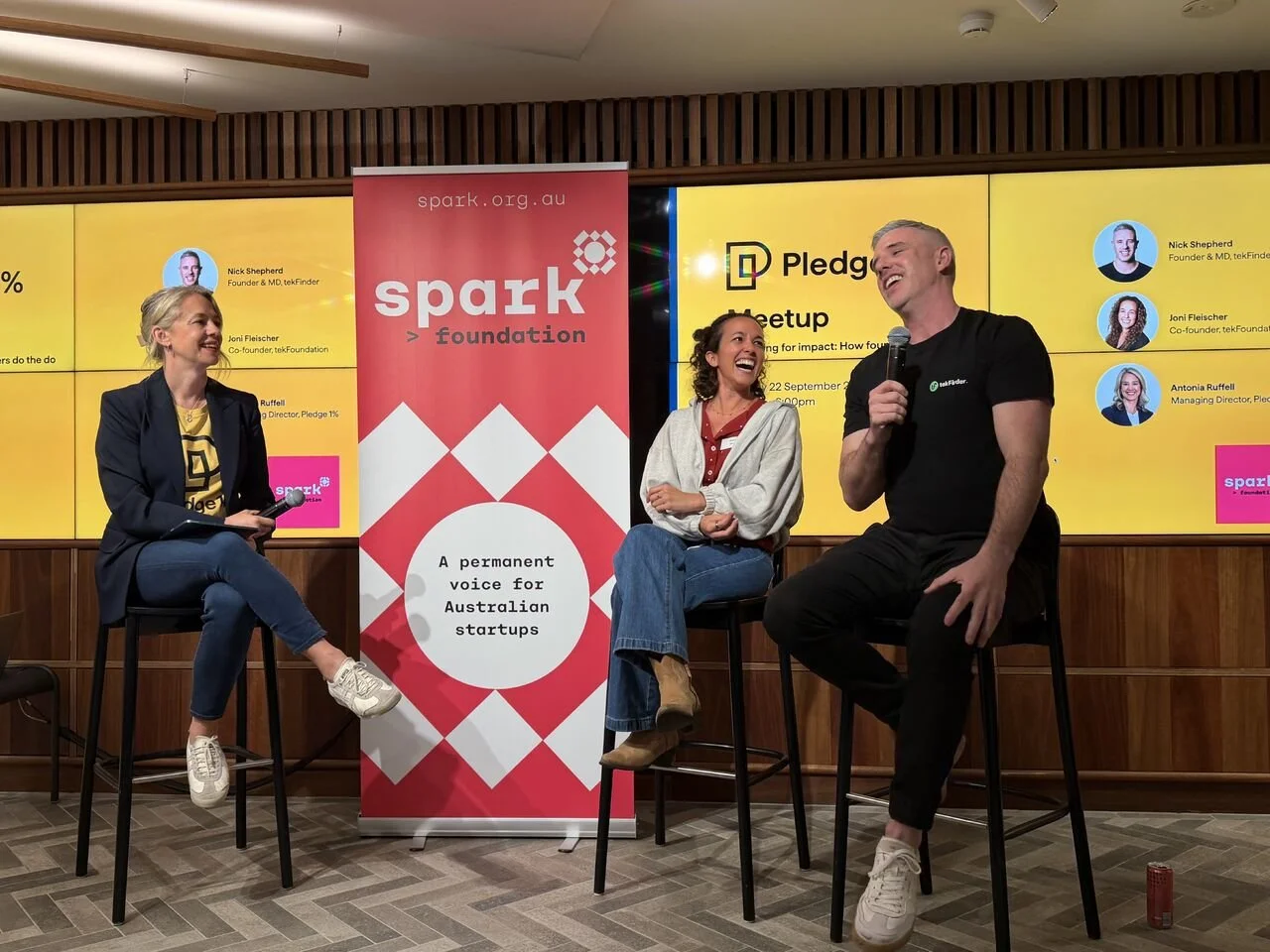
This month Nick and Joni Fleischer, co-founder of tekFoundation, spoke at the Pledge 1% meetup, hosted at Canva as part of Sydney’s Spark Festival.
The session was about what it actually takes to build a giving programme from scratch when you are a small business. Not the polished version. The real one, including the parts that did not go to plan and the lessons that came with them.
The point they kept coming back to is that you do not need to be big before you start. A percentage of something small still counts, and the habit is far easier to build early than to bolt on later.
Missed one?
Every edition of State of Play is in one place. What we were hearing, what moved on pay, and what we got wrong. Worth a look if you want to see how quickly some of this has changed.